Path ID: DB01395_MESH_D065446_1
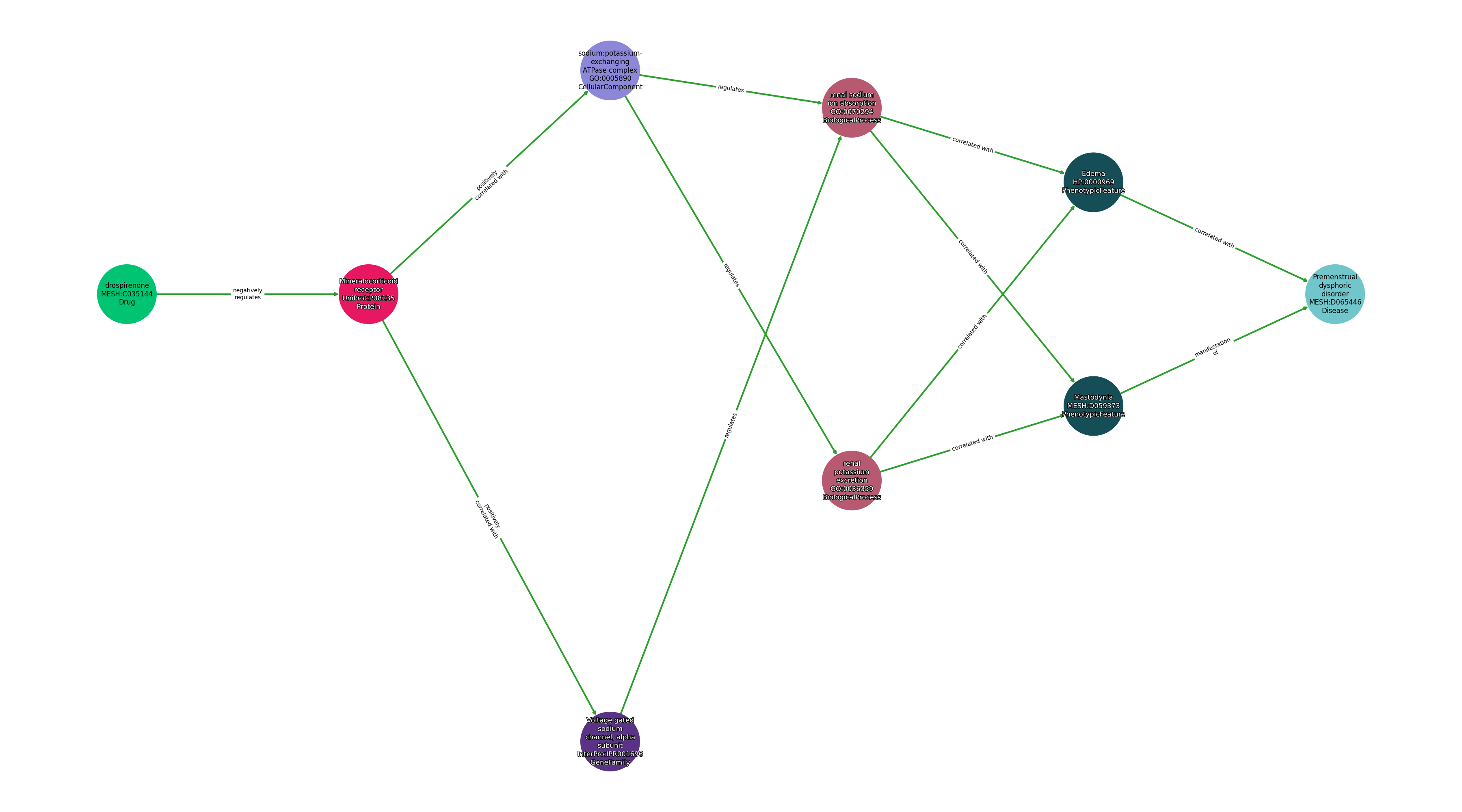
Concepts
| Identifier | Name | Type |
|---|---|---|
| MESH:C035144 | drospirenone | Drug |
| UniProt:P08235 | Mineralocorticoid receptor | Protein |
| InterPro:IPR001696 | Voltage gated sodium channel, alpha subunit | GeneFamily |
| GO:0005890 | sodium:potassium-exchanging ATPase complex | CellularComponent |
| GO:0070294 | renal sodium ion absorption | BiologicalProcess |
| GO:0036359 | renal potassium excretion | BiologicalProcess |
| HP:0000969 | Edema | PhenotypicFeature |
| MESH:D059373 | Mastodynia | PhenotypicFeature |
| MESH:D065446 | Premenstrual dysphoric disorder | Disease |
Relationships
NOTE: predicates are annotated in Biolink Model (v1.3.0)
| Subject | Predicate | Object |
|---|---|---|
| Drospirenone | NEGATIVELY REGULATES | Mineralocorticoid Receptor |
| Mineralocorticoid Receptor | POSITIVELY CORRELATED WITH | Sodium:Potassium-Exchanging Atpase Complex |
| Mineralocorticoid Receptor | POSITIVELY CORRELATED WITH | Voltage Gated Sodium Channel, Alpha Subunit |
| Sodium:Potassium-Exchanging Atpase Complex | REGULATES | Renal Sodium Ion Absorption |
| Sodium:Potassium-Exchanging Atpase Complex | REGULATES | Renal Potassium Excretion |
| Voltage Gated Sodium Channel, Alpha Subunit | REGULATES | Renal Sodium Ion Absorption |
| Renal Potassium Excretion | CORRELATED WITH | Edema |
| Renal Sodium Ion Absorption | CORRELATED WITH | Edema |
| Renal Potassium Excretion | CORRELATED WITH | Mastodynia |
| Renal Sodium Ion Absorption | CORRELATED WITH | Mastodynia |
| Mastodynia | MANIFESTATION OF | Premenstrual Dysphoric Disorder |
| Edema | CORRELATED WITH | Premenstrual Dysphoric Disorder |
Comment: The use of progesterone, progestin and similar compounds may not be superior to placebo in reducing premenstrual symptoms judging from the results of the majority of controlled trials (https://pubmed.ncbi.nlm.nih.gov/7791258/). Also note that it is generally agreed that neither a deficiency nor excess in progesterone/progestin levels is etiologically relevant to the disorder (https://pubmed.ncbi.nlm.nih.gov/16650465/). It’s largelly accepted that SSRIs as better treatment and should be the first attempt for treatment of premenstrual dysphoric disorder.
Reference: